
Introduction: Personal Journey and Inspiration
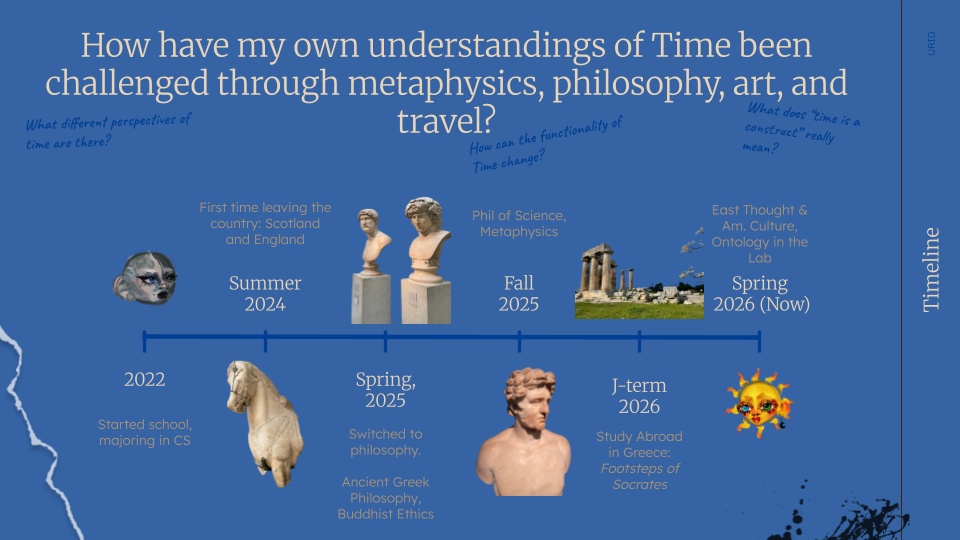
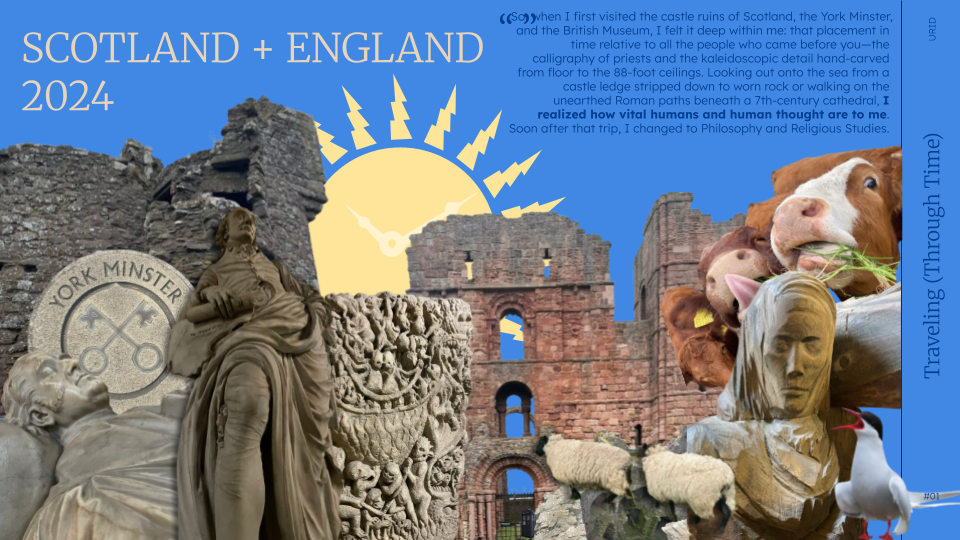
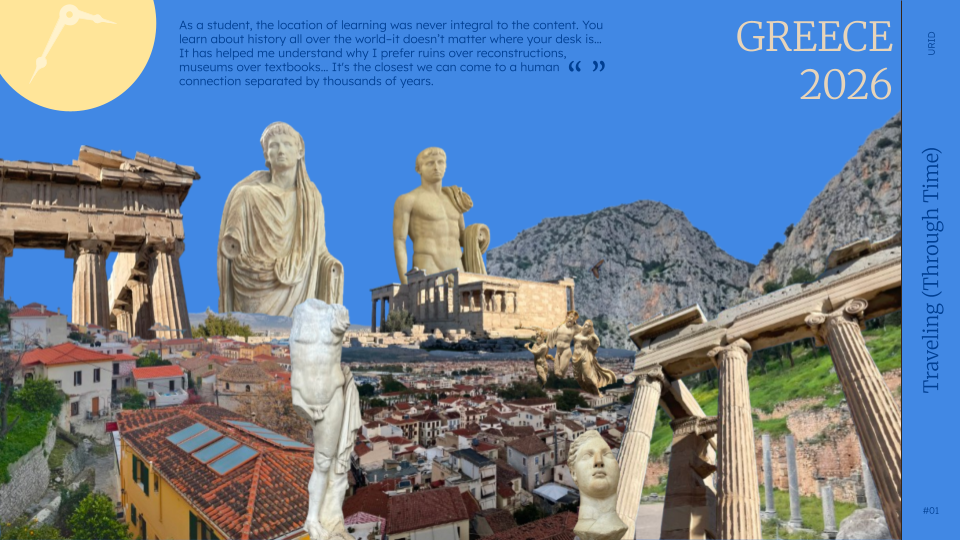
Over the past few years, I have cultivated a deep interest in the philosophical, religious, and artistic history spanning from ancient to medieval times. This journey was profoundly shaped by a summer trip in 2024, during which I visited Scotland, York, and London. Interacting with ancient structures like York Minster, the Roman foundations beneath its crypt, and the inscribed Latin words, marking graves and memorials, connected me to a distant past in a visceral way. Standing on Roman paths or gazing at stone inscriptions, I felt an undeniable link to those who came before me. This experience ignited my love for history and the human thought embedded within these relics, inspiring me to explore the concept of Time through an interdisciplinary lens.
Exploring Time Through Travel and History
Traveling through these historic sites made me realize how humans and their ideas are woven into the fabric of history. Whether standing on Roman paths or observing the kaleidoscopic carvings of York Minster, I felt that we are all part of an ongoing story, one that spans cultures and centuries. These experiences emphasize Time as a plural, layered phenomenon, embedded in cultural artifacts, architecture, and personal encounters. They reveal that our understanding of Time is not monolithic but multifaceted, shaped by history, art, religion, and individual perception.
Philosophical Foundations: Time and Metaphysics
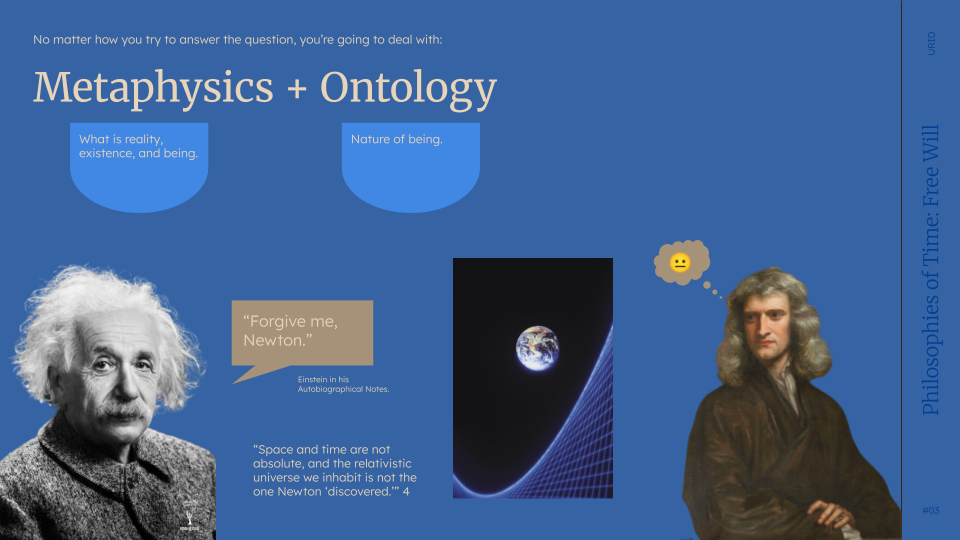
My philosophical exploration began with questions about the nature of reality and existence, metaphysics, and ontology. Drawing from the debates between Newton and Einstein, I examined how different ontological commitments influence our understanding of Time. Newton viewed space and time as absolute, fixed entities, a backdrop to the universe’s unfolding. In contrast, Einstein’s relativistic universe suggests that space and time are interconnected and relative, fundamentally altering how we perceive reality. This inquiry underscores that Time is not a static backdrop but a dynamic, multi-dimensional fabric that shapes and is shaped by our understanding of the universe.
Theories of Time and Causality within the Free Will Debate
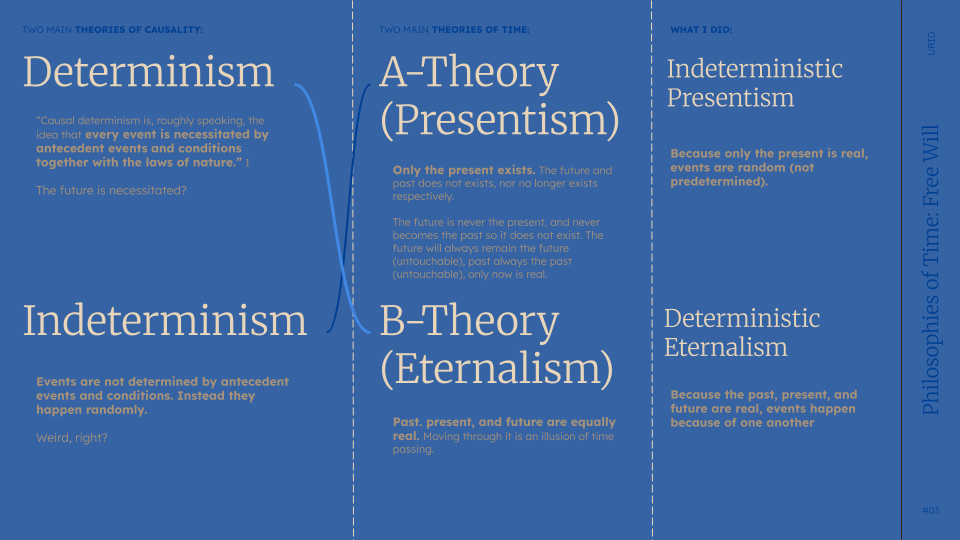
In my research, I delved into the two primary theories of time, Presentism and Eternalism, and their relation to causality:
Presentism posits that only the present moment is real; the past has ceased to exist, and the future has not yet come into existence.
Eternalism suggests that the past, present, and future are equally real, and our perception of time passing is an illusion.
When integrating these theories with notions of causality, I developed the concepts of Indeterministic Presentism and Deterministic Eternalism:
From my paper, “Time is a Part of Free Will Remaining a Mystery”:
“Determinism and presentism are not compatible. Although presentism would not deny the past and laws of nature, it would deny that it entails a unique future. The future does not exist in presentism. Indeterminism holds that events are neither caused deterministically nor by chance. Indeterminism says nothing about the future, so it seems it is compatible with presentism. Conversely, determinism and eternalism are compatible: if the past, present, and future all exist, then the past and the laws of nature that entail a single possible future are consistent. If the future already exists, then it cannot be undetermined, so determinism is not compatible with eternalism.”
Even within the technical philosophical debates about free will, the structure of time is not fully accounted for when thinking about causality, which depends on it. Indeterministic Presentism and Deterministic Eternalism show how incorporating theories of time into theories of causality alters how they work. Indeterministic Presentism holds that, because only the present exists, it cannot be presupposed by a chain of causal events. This helps with indeterminism by removing the “randomness” of current events. Deterministic Eternalism says that everything is causally determined because it is predetermined. This provides an explanation for the necessity of the future. Although this does not point to an obvious compatibilist or incompatibilist answer for free will and causality, it helps narrow the avenues of philosophical debate by providing more exact rules for what we can and cannot presuppose within each theory.
Eastern Thought and American Culture: The “American Time Paradox”
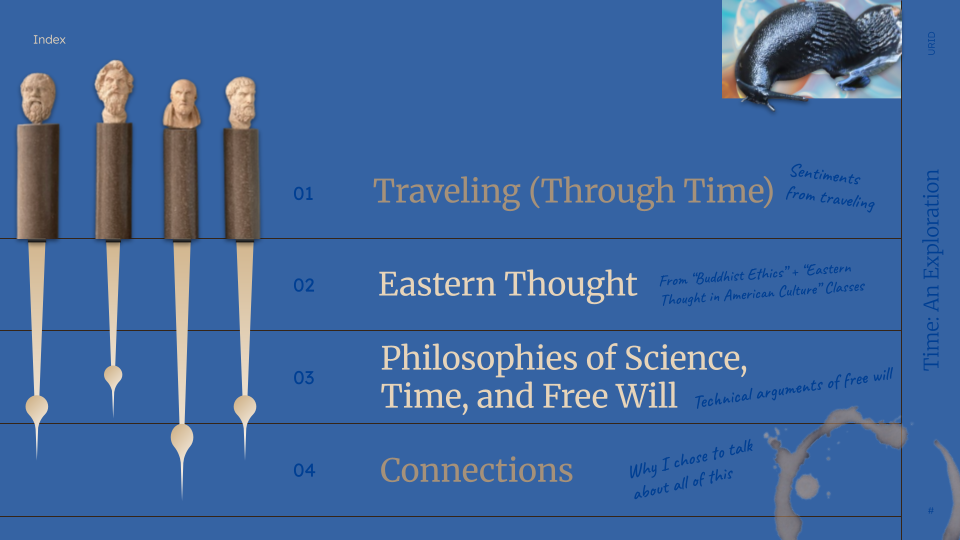
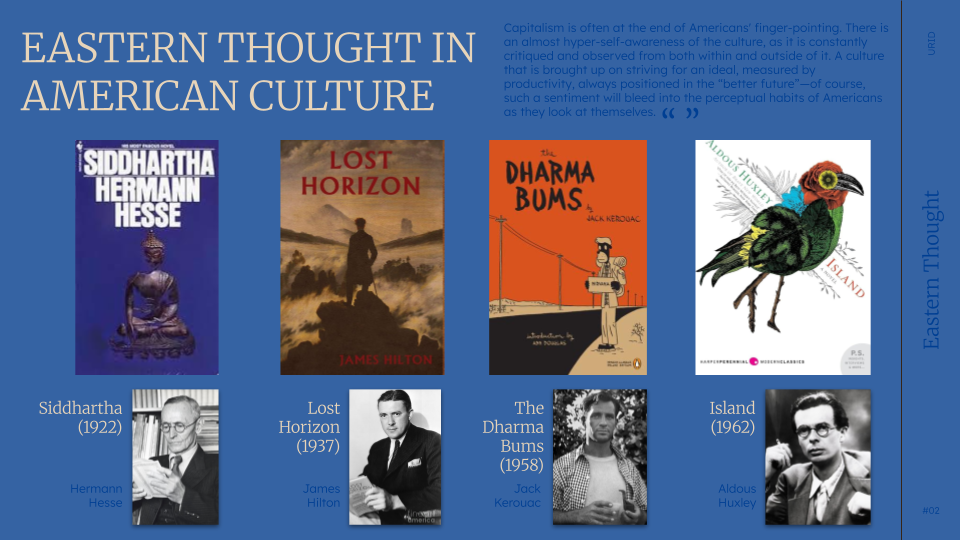
The term Eastern Thought broadly encompasses philosophies from Hinduism, Buddhism, Daoism, and Zen. After WWII in the United States, despite a booming economy and capitalism at its peak, strong countercultural movements emerged in the West, heavily rooted in Eastern Thought. These movements, many inspired by Western authors, idealized the East as a utopia free from the relentless pressures of productivity, where individuals could genuinely live in the moment.
Notably, three foundational novels associated with these movements during this time, Siddhartha by Hermann Hesse, The Dharma Bums by Jack Kerouac, and Island by Aldous Huxley, are by American authors. These works depict the East as a space of spiritual liberation, critiquing the productivity-driven mentality of American capitalism. They portray a culture obsessed with the future, always striving, always planning, yet rarely pausing to truly live in the present. This critique, paradoxically, originates from a future-oriented, productivity-driven mindset itself.
I have termed this phenomenon the “American Time Paradox”: the cultural tendency to label “thinking in the future” as bad and “living in the present” as good. In America, Time is deeply tied to notions of freedom, freedom to succeed, to progress, to control one’s destiny. However, this obsession with the future often leads to a neglect of the present moment, an ironic consequence of a culture that venerates progress yet struggles to find fulfillment in the here and now.
Furthermore, Time influences core values like liberty and freedom. The American critique of capitalism often points to its productivity obsession, but the critique also exposes how Time, especially future-oriented thinking, shapes perceptions of individual freedom. This hyper-awareness of culture, combined with a constant critique from within and outside, sustains the “Time Paradox,” revealing how deeply intertwined Time is with American identity and its aspirations.
Personal Reflection & Interdisciplinary Approach
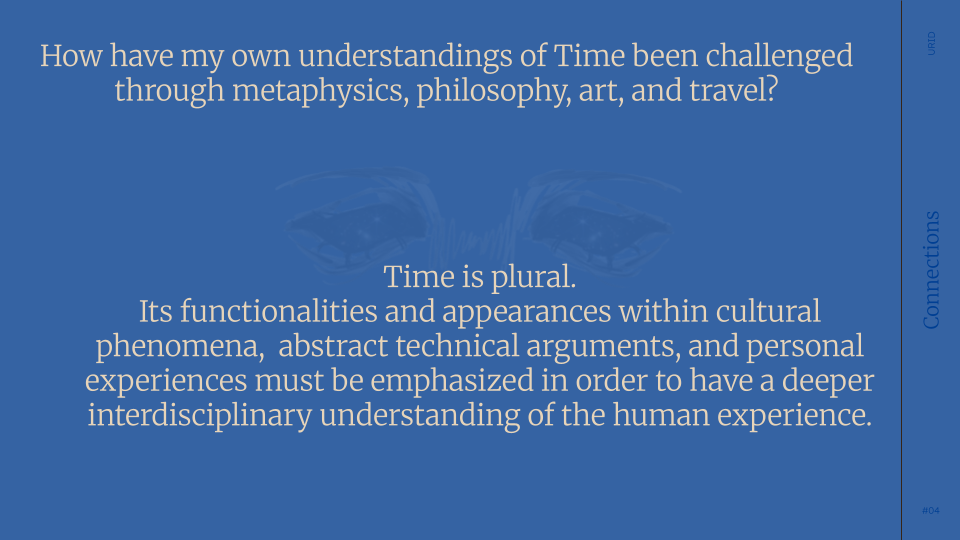
My capstone emphasizes that Time is not merely a scientific concept but a layered phenomenon, encompassing cultural, artistic, religious, and philosophical dimensions. It is a deeply personal experience, a historical construct, and an artistic expression. The interdisciplinary approach reveals that our understanding of Time is shaped by underlying assumptions, preconceptions, and unexplored avenues, much like philosophy itself.
For example, I have come to see how scientism, the belief that science provides the ultimate authority, pervades our understanding of Time and knowledge. This overreliance can obscure other valuable perspectives, such as those from the humanities or spiritual traditions. Recognizing these limitations invites us to broaden our inquiry and appreciate Time as a multifaceted, culturally embedded phenomenon.
Conclusion
Through this project, I have gained a deeper appreciation for the complexity of Time. It is a plural, layered concept that intersects with nearly every aspect of human thought and culture. My interdisciplinary exploration has reinforced the idea that understanding Time requires openness to multiple perspectives, scientific, philosophical, artistic, and personal, and that often, the most profound insights emerge at their intersections. As I continue my academic journey, I look forward to further exploring these themes, knowing that Time is ultimately a reflection of our shared human experience as an ongoing story that connects us across centuries.


Leave a Reply